A calm and mindful way to welcome 2026
This is always one of my favourite walks in the calendar: starting off by seeing the sun rise is a beautiful way to greet the year (I’m also not one for fireworks or late nights, so this definitely suits me better).
Having checked in with each other first, I invited the group to take notice of all the different scales with a poem I wrote (see Poetry Corner, below), an invitation to mindfully connect with the world around us.
This year dawned cold, crisp and bright as we gently wandered up from New Quay along Long Marsh Lane. We stopped to observe some black-headed gulls (it’s more of a chocolate brown) who are not yet in full breeding plumage so their heads appear patchy right now. They have red beaks and legs, are smaller than other gull species, and tend to be together in larger numbers. They also have a white leading (front) edge to their wings, which is quite distinctive in flight. After a few minutes observing, I noticed they were watching us too, so we moved on to leave them in peace.
A golden morning of beautiful birds
As we turned onto the cycle path at Quay Meadows we soon noticed a few birds and bird songs, and there was quite a lot of activity. On such a cold morning (and after an unseasonably warm start to winter), the birds were in need of food to help sustain them.
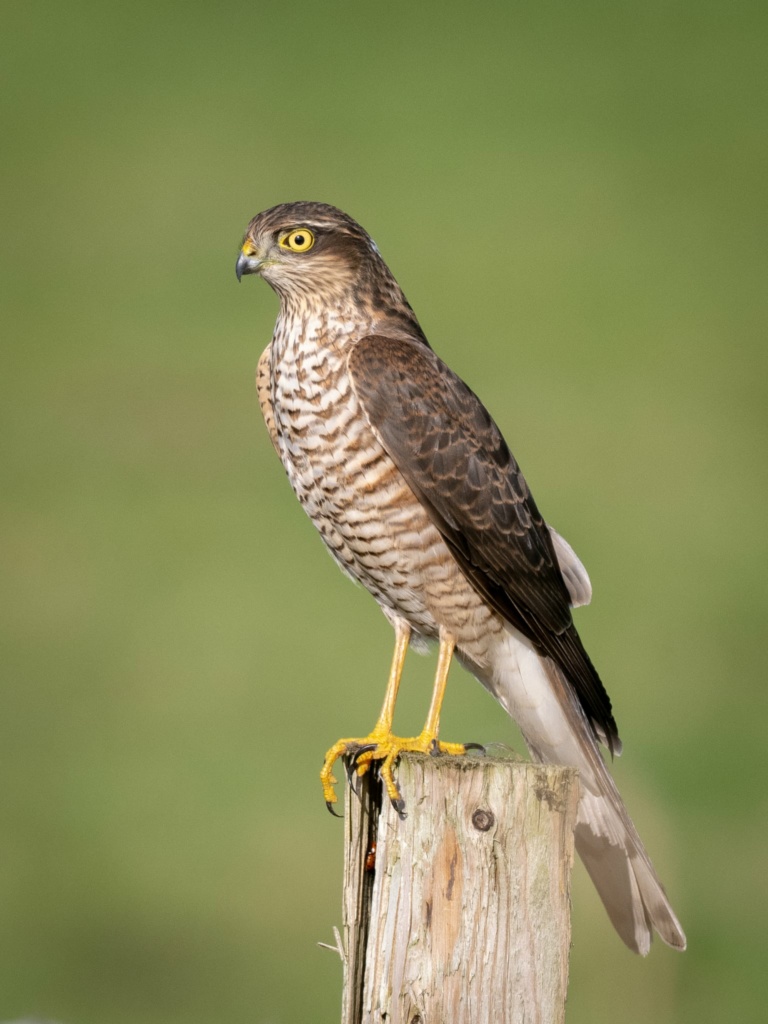
As we paused below the Priory to talk about the cemetery (it extends all the way down to the cycle path, although with fewer headstones on the steep hill), we heard a commotion above us and saw a sparrowhawk (like the female here, by Chris Armstrong, a local wildlife photographer). It landed briefly in a tree, before being chased off again, and we gained a glimpse of a second bird. I wonder if they are starting to pair up ahead of the spring?
Side note – In many bird of prey species, the female is significantly larger than the male. Why? As apex predators, they are reliant on availability of their prey, and, if they are competing with each other they are less likely to be successful. So, with different sizes, they occupy slightly different niches (in terms of prey size). The sparrowhawk shows one of the largest differences (dimorphism) in size between the sexes, with females u to 25% larger, and picking prey items up to 2.5 times larger. A study from 2021 (summarised in The Scotsman) indicated that females had a preference for wood pigeon, whilst the smaller (and therefore more agile) males took mostly sparrows (as their name suggests!) and starlings.
Shortly after this, as we continued on along the cycle path, I heard the call of a goldcrest, which suddenly appeared before us, low down in a shrub. For any keen birdwatchers out there, you’ll know that this is a pretty rare occurrence. Normally, these busily-active little birds are found high up in evergreen trees. So this was a particularly magical encounter.
Side note – not sure if this is apocryphal, but a quick internet search suggests that goldcrests were considered to be symbols of luck, fortune and even spiritual guides. True or not, I rather like the thought that this is how our year started!
After watching the goldcrest for a couple of minutes (close enough that we could see its crest without the aid of binoculars) we carried on along our walk, stopping to take a look at the river Lune near Millennium Bridge before continuing on up the path towards the Priory.
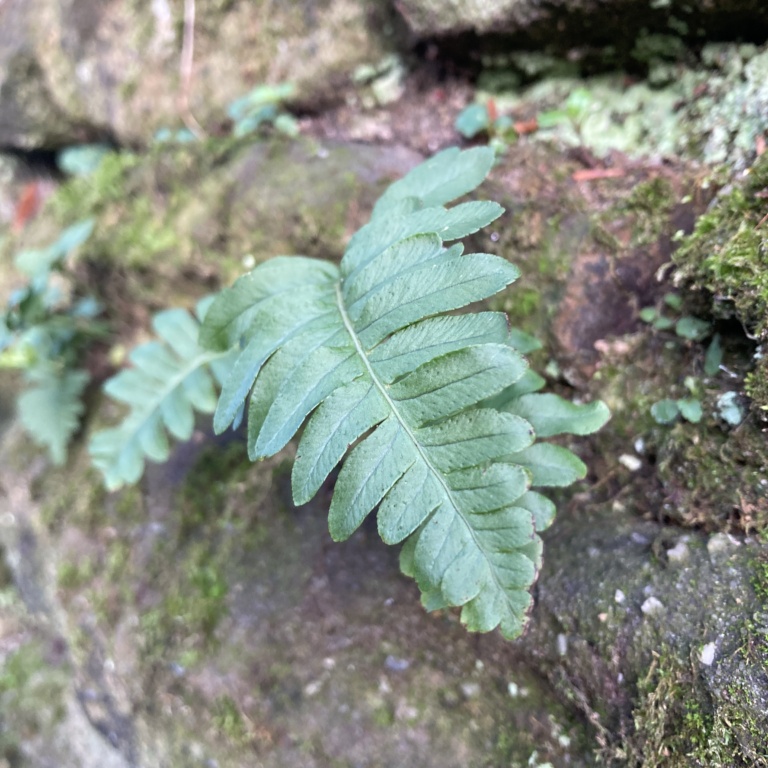
We concluded our walk taking time to notice what we could see on the wall at the bottom of the Priory steps. Spotting ferns, like this one (a species of polypody), mosses, lichens and ivy-leaved toadflax.
On New Year’s Eve I had been reading Gathering Moss by Robin Wall Kimmerer, and she described how mosses are unable to regulate their levels of water which is known as poikilohydry (unlike most ‘higher’ plants which are homoiohydric, i.e. able to regulate through means such as closing leaf pores to reduce water loss).
Side note – you may have heard the term poikilothermic in secondary school biology. It refers to animals that cannot regulate their temperature, such as reptiles. This is why snakes bask in the sun, to gather energy for the day ahead. Mammals and birds, however are homeothermic, able to regulate body temperature through e.g. panting and sweating or shivering.
For most plants, drying out completely would mean death, but for these little miracles of nature, it just means they go into suspended animation. They are unable to grow as they cannot photosynthesise, but can be revived with water decades after they have dried out.
This felt like a wonderful metaphor for going with the flow, and a lovely way to end our walk: I look forward to going more with the flow of nature and the seasons this year.
Happy New Year everyone.
Poetry corner - The Scales of Nature
The Scales of Nature are more varied than we know,
Think magnitude, song, physiology, metaphor.
Take notice enough to experience what’s there,
Outside of our heads in the wondrous world.From atoms and cells, microbes and viruses,
Right up to the redwoods and whales.
Life inhabits niches, landscapes, and biomes,
What scales of size will you notice today?There’s noise all around us in the natural world,
Singing, humming, buzzing, and rustling.
A wild orchestration that never ends,
What musical scales will you hear today?
In the overlapping structures that nurture and protect,
Leaves that are budding, fishes, snakes, seeds and more.
Life repeats patterns across kingdoms and species,
What anatomical scales could you see today?The awesome, intricate, complex webs of life,
How tough, and yet delicate, how much can they take?
Can we, this one species, let them fall from our eyes,
These scales: before we tip their balance too far?
(c) Ros Jones, January 2026