A different perspective
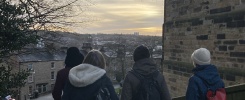
January can be a tough month, and I found the last couple of weeks particularly hard (and with a stinking cold to cap it all off in the final days!). So it was lovely to get out on Saturday 24th with the group on this cold but sunny January morning. The stiff breeze felt like a welcome (if chilly!) way of blowing away some of the cobwebs.
We began the walk along the canal – the reverse of the way we usually go – to get a new perspective. This was very much the theme for the walk: seeing the same things from different viewpoints (more on that later).
As we walked along the canal, we appreciated the colours of the weeping willow, one of the first trees to show real spring colour, and most of the group were lucky enough to get a fleeting view of a kingfisher as it darted, low to the water around the corner at Aldcliffe.
Welcoming different perspectives
On entering Pony Wood we spent some time looking closely at hazel. It was interesting to discuss the different things we noticed, as well as the similarities. It can be so easy to get wrapped up in our own world view, so seeing things from someone else’s perspective increases our connection, and widens our horizons.
We then heard some noise in the trees and I realised this was a sound I knew from the South East; ring-necked parakeets! These gregarious and brightly coloured birds have been spreading north from releases in the home counties since the 1960s and have been very successful. My initial reaction was one of concern as these are considered an alien invasive species and can compete for food and resources with our native birds. But it’s not their fault.
Side note: Ring-necked or rose-ringed parakeets originate from tropical north Africa and the Indian sub-continent, with established populations across much of north-western Europe and elsewhere in the world. This is the UK’s only naturalised parrot species. There is evidence of competition for nesting sites (and fatal attacks) on the great noctule bat in Europe. It is also widely accepted that they aggressively compete for nesting sites with other birds, e.g. starlings, woodpeckers, owls and nuthatches. Whatever the effect of this bird, it’s here to stay, and on a cold and drab winter’s day, they certainly brought colour, noise and interest.
As we walked down through to the bottom of the wood we had wonderful views of a treecreeper (see Poetry Corner, below) and a close encounter with a jay (see image, right, by Chris Armstrong) which was noisily announcing its presence.

Image of a Jay (Garrulus glandarius) © by Chris Armstrong.
The jay is our most colourful member of the corvid (crow) family, and is associated with oak woodlands – they can be seen with a heavily filled crop (expandable pouch) in a mast (unusually large number of seeds) year!
Winter birds and the beauty of a mossy world

Moss (Grimmia sp.) on a wall at Fairfield Nature Reserve. Photo © by Ros Jones.
Mosses are remarkably well adapated to their environment. This species forms dense cushions which help to retain moisture and the long, white, hair-like tips to its leaves help to increase surface area for capturing moisture both from rainfall and dew/mist. The leaves will also curl inwards as it dries, preserving the last bits of moisture.
Grimmia are a common family of mosses, found on walls. Species can be tricky to identify from each other (some requiring microscopic examination of cell structure!).
We stopped for quite a while at the bottom of Pony Wood to look at the feeding tables, noticing that a section of the hedgerow has recently been laid. The cut scrub has been left in piles adjacent to the hedgerow, providing cover for the wintering birds coming to feed in the field.
The low tables that are regularly refilled with food (and the cage for smaller birds to exclude, e.g. pigeons and corvids) attracted a range of species, including chaffinches, blue tits, great tits, blackbirds, reed bunting and robins.
We stood for a couple of minutes, facing the warmth of the sun: in this spot we were quite sheltered from the cold wind, so it was a lovely moment. When we close our eyes, our sense of hearing comes more into focus, and it was lovely to listen to the blue tits in the trees above us, calling to each other.
As we moved on from the wood, we stopped and took a close look at some moss on the wall, marvelling at this miniature world and the tenacity of moss to survive some seriously harsh conditions.
Side note – I’ve been reading up quite a lot on mosses in Robin Wall Kimmerer‘s excellent book, Gathering Moss. Having studied botany 20-odd years ago and used moss test species in my PhD, it is lovely to come back to these remarkable organisms. They are so well adapted to drying out (see the New Year’s Day walk report for more information), but physics also plays a role in them retaining moisture as their stature means they sit beneath the boundary layer where the air is more still, warm and humid.
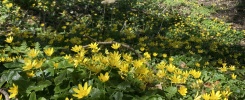
The last stretch of our walk, took us along the lane back towards either Willow Lane or the Orchard. This high-sided, sheltered stretch showed signs of the warm winter and early spring with cow parsley, cleavers, red campion and other species already well advanced.
Poetry Corner - Treecreeper
Treecreeper, treecreeper: it’s exactly what you do,
Creeping up trees, searching for food.Little white bellies and cryptic brown backs,
Your feet & curved beaks help you find snacks.You creep, like a mouse, ’til you reach the tree’s top,
Then with a ‘tseep’ to the base of the next one you drop.Treecreeper, treecreeper, it’s exactly what you do.
It’s always a joy to catch sight of you.
Poem © by Ros Jones (05-02-2026).
Image of treecreeper, (right) © by Chris Armstrong