Finding our pace
Spring is officially here, and the days are now officially longer than the nights. Mid-March brought us some much warmer (unseasonably so) weather, and we’ve had a really good run of sunny days, so it was a joy to get out and see how much things have changed over the last few weeks.
We began our walk along the historic stretch of St George’s Quay, taking a moment, as always, to pause, breathe, and gently arrive.
Everyone was invited to find a slow presence in the here and now. This simple act of grounding set the tone for a walk rooted in curiosity and calm connection.
Transitions in time and space
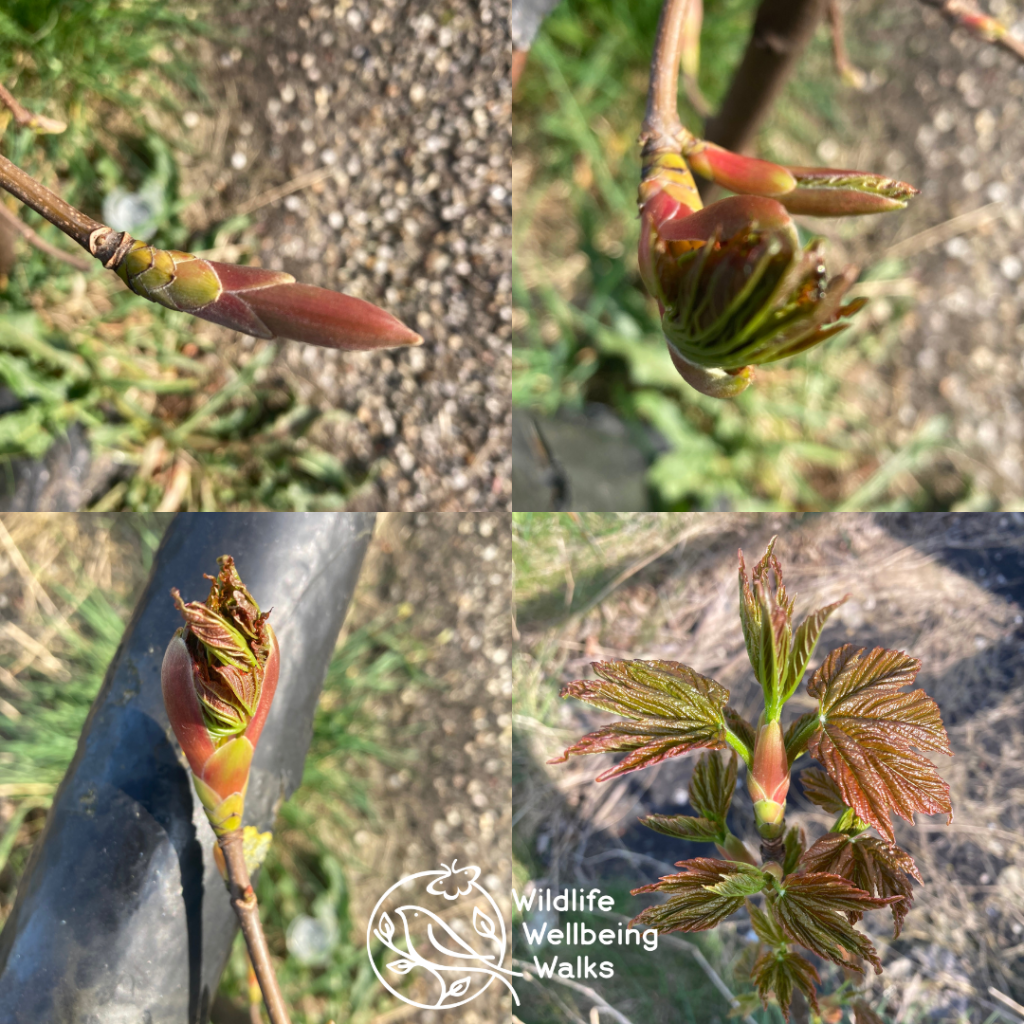
Images of Sycamore (Acer pseudoplatanus) buds with leaves unfurling © by Ros.
A common sight, Sycamore is a naturalised tree species. Not native since the last ice age, it has settled in the UK following widespread planting since the 1700s. Reports vary on when it was first introduced, as early as the Roman era, or as late as the 1500s!
This is an often maligned species as it is fast-growing, seeds prolifically and throws up lots of suckers even if it is cut. In more sensitive habitats it may, therefore, be managed more aggressively. However, it does provide a lot of value to native wildlife, and they have a reasonable life-span of 200-400 years. They are also pretty tolerant to high winds and pollution, which perhaps explains why they do well in Lancaster where other species do not thrive.
The first thing we observed were the black-headed gulls, where most were now almost fully into their chocolate-brown hoods (breeding plumage) with only a few light smudges. This is part of their annual moulting cycle where the initial white feathers get worn away, revealing the brown ones beneath. It was a lovely example of some of the subtle shifts that are happening through the seasons, if only we stop long enough to take notice.
Our next example of this was in seeing the familiar buds of sycamore unfurling, seeing the tightly packed leaves as they expanded, with the cells having been there in the tiny buds since they were formed last summer. The image on the right shows the different stages of unfurling.
Side note: the leaves we see now as the open and slowly expand have been there in the buds which formed last summer. These buds were no more than a centimetre over the winter, swelling to 3-4 times that size by the time they finally burst out of the protective bud scales. The miniature leaves within the buds undergo rapid changes due to the release of certain plant hormones, leading to the emergence of the leaves.
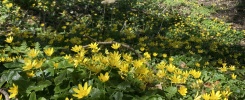
As we transitioned away from the river, walking up the ancient stone steps to join the cycle path below the Priory, we heard sparrows cheerfully chirping and other birds such as blackbird in full song. Turning into the path for quay meadows we spotted some lesser celandines in full flower, in the raised embankment. The glossy yellow petals were gleaming in the spring sunshine, and we talked a bit about bee guides and how they see the flowers differently from us.
Side note: although humans see more or less uniform yellow petals, bees see something quite different, with UV nectar-guides (invisible to the human eye), providing a striking pattern to the insects, guiding them in to the flower’s pollen and nectar resources. It’s a win-win with the bees finding their food source more efficiently (saving energy) and improving the plant’s chances of successful pollination. A great example of co-evolution.
Pin & thrum, roe deer, and bee's hum
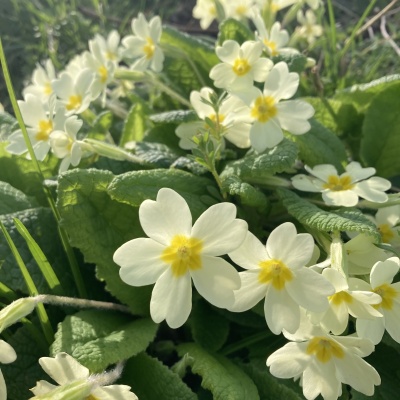
Primrose (Primula vulgaris) Photo © by Ros Jones.
These early-flowering plants are native to the UK and are closely related to Cowslips (Primula veris). They are able to prevent self-pollination through the positioning of their stamens and anthers (male reproductive parts) in relation to the stigma and style (female parts). This is known as either pin (where the stigma sits higher up in the flower tube than the pollen-bearing anthers) and thrum (where the reverse is true). One plant will only ever have either pin or thrum flowers, and fertilisation can only occur between pin and thrum (not pin to pin or thrum to thrum), ensuring that cross-pollination always occurs.
The fields towards the railway in quay meadow are an interesting mix, with trees and shrubs around the perimeter and grassland in the middle. We noticed a good number of snakes head fritillary flowers, which a couple of us thought may not have previously been present, so perhaps someone has planted a few of these native bulbs. We spent a while looking closely at primrose flowers growing underneath the trees towards the western edge to distinguish between pin and thrum flower morphology (see image, left for more information), before moving into the meadow. I spotted a beautiful tawny mining bee which was wonderfully bright in the sunshine. It even landed on my foot, briefly, before going on its way.
Side note: tawny mining bees are a species of Andrena and has a less common cousin in the same genus, the ashy mining bee. As the name suggests, they dig holes (in sandy soils) to create their nests where they will lay their eggs.
As we moved further up the meadow, we saw leaves emerging, and ash in flower. And then a roe deer came out into the middle of the meadow, bold as brass, and completely unconcerned by the people stood around. It was lovely to see an animal getting on with its day, not worried by our presence, and yet gifting us such good views.
Side note: roe deer are a native UK species, easily identifiable by their characteristic white bottom and grey-brown coat. They are a medium-sized species, and commonly found in parks.
The walk ended with a gentle wander back along the cycle path then up towards the priory, where we spotted more lesser celandines, primroses and snakes head fritillaries.